Global Economy Outlook 2025: Slow Growth, Rising Caution
The IMF’s October 2025 World Economic Outlook predicts global growth slowing to 3.2%, citing inflation, trade tensions, and policy uncertainty across advanced and emerging economies.
 vishalyadav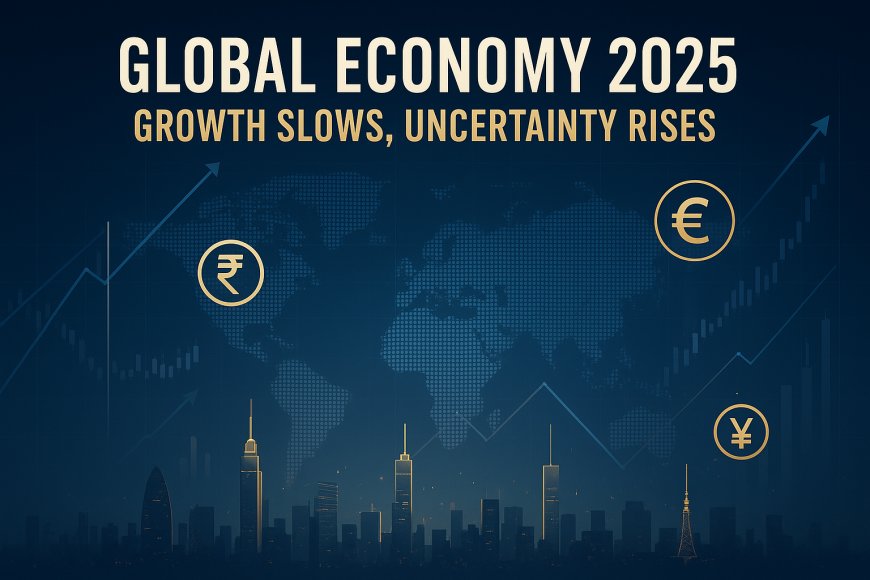
The International Monetary Fund (IMF) has released its October 2025 World Economic Outlook, painting a cautious picture of the global economy. Despite modest resilience in consumer spending and labor markets, global growth is expected to slow to around 3.2% in 2025 and further ease to 3.1% in 2026. The report highlights a period of uncertainty shaped by geopolitical tensions, sluggish trade recovery, and tightening financial conditions.
Advanced Economies Face Structural Challenges
Developed nations are projected to grow at an average of 1.5%, with the United States, Eurozone, and Japan all struggling with low productivity and high debt levels. Persistent inflation pressures, especially in housing and services, continue to challenge central banks. While rate cuts may be on the horizon, policymakers remain cautious about reigniting inflationary trends.
Emerging Markets Show Relative Strength
In contrast, emerging and developing economies are forecast to grow slightly above 4%, led by India, Indonesia, and parts of Africa. India remains a bright spot, maintaining strong domestic demand, government investment in infrastructure, and a thriving technology sector. However, global supply chain shifts and commodity volatility could still dampen export performance in the developing world.
Trade and Investment Flows Under Pressure
Global trade growth remains below pre-pandemic levels, constrained by protectionist policies, supply chain diversification, and weaker manufacturing output. Foreign direct investment (FDI) has slowed, reflecting investor caution amid geopolitical tensions between major economies like the U.S. and China. The IMF warns that prolonged trade fragmentation could cut global GDP by up to 7% in the long term.
Energy and Climate: The Dual Challenge
The transition toward clean energy continues, but uneven progress between advanced and developing nations risks widening the energy gap. While renewable investments have surged, fossil fuel demand remains high in Asia and parts of Africa. Climate-related disruptions — including droughts, floods, and food supply shocks — further complicate economic planning for vulnerable economies.
Monetary and Fiscal Balancing Act
Central banks worldwide are walking a fine line between supporting growth and controlling inflation. Many countries have limited fiscal space after years of pandemic spending, leaving less room for large-scale stimulus. The IMF recommends targeted fiscal support for vulnerable populations, alongside structural reforms to improve productivity and competitiveness.
The Road Ahead
The 2025 global outlook underscores that economic growth is stabilizing but far from robust. The combination of slowing trade, weak investment, and persistent inflation could make the next few years challenging. Yet, the digital economy, green transition, and AI-driven productivity improvements offer hope for renewal — provided that nations invest wisely and cooperate internationally.