
Google Appoints Amin Vahdat to Lead Its Global AI Infrastructure Expansion
Google names Amin Vahdat to lead its global AI infrastructure expansion, boosting data-centre growth, custom silicon development, and sustainable AI computing.
 vishalyadav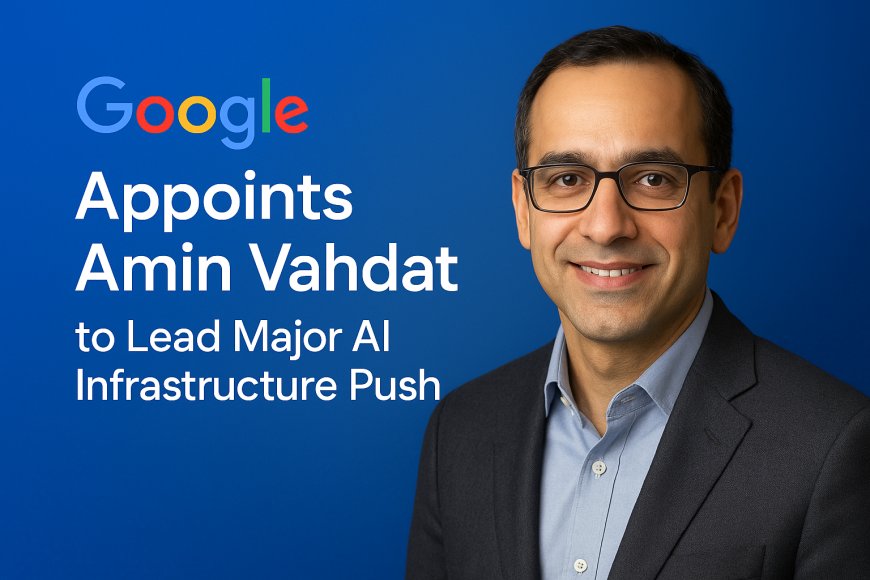
Google has taken a bold strategic step by appointing renowned computer scientist Amin Vahdat to spearhead the company’s global AI infrastructure expansion. This move underscores Google’s accelerating push to build a stronger foundation for the next generation of artificial intelligence — one that demands unprecedented compute power, massive data-centre upgrades, and breakthrough networking technologies.
Why This Move Matters
Artificial intelligence has evolved from a software-driven innovation to an infrastructure-intensive revolution. Modern AI models — whether powering search, language models, robotics, or autonomous systems — require enormous computational muscle. Google understands that the future of AI leadership depends not only on algorithms but on the scale, efficiency, and capabilities of the underlying infrastructure.
By placing Amin Vahdat at the helm, Google is signalling three key priorities:
1. Building Next-Generation Data Centres
AI workloads are radically different from traditional cloud processes. They need:
-
High-density GPU and TPU clusters
-
Ultra-fast connectivity
-
High-efficiency cooling systems
-
Energy-optimized compute environments
Vahdat, known for his expertise in high-performance networking and distributed computing, is expected to drive transformative redesigns across Google’s global data-centre fleet.
2. Scaling AI Compute for the Long Term
Google’s ambitious AI roadmap — including Search enhancements, Gemini AI models, and enterprise cloud offerings — demands long-term scalability.
The company is focusing on:
-
Expanding custom silicon (TPUs)
-
Enhancing multi-region compute orchestration
-
Strengthening reliability for continuous AI operations
Vahdat’s leadership will be central to ensuring that Google’s compute backbone stays ahead of competitors like Nvidia-backed cloud platforms, Amazon, and Microsoft.
3. Advancing Sustainable AI Infrastructure
With AI models consuming rising amounts of energy, sustainability is becoming a critical focus.
Google aims to:
-
Integrate greener technologies
-
Reduce carbon footprint per training cycle
-
Improve power usage effectiveness (PUE) across facilities
Vahdat is expected to guide innovations that allow Google to scale AI responsibly — balancing performance with environmental impact.
What This Means for Google’s Future
Google’s decision reflects a wider industry trend: AI is the new battleground for cloud giants, and infrastructure is the core differentiator.
Under Vahdat’s direction, Google could:
-
Deliver faster and more capable AI services
-
Bring high-performance compute to more global regions
-
Strengthen its position in enterprise AI and cloud markets
-
Support more advanced and larger AI models in coming years
It also positions Google to compete with emerging threats — including specialized AI cloud providers and chipmakers reshaping the compute landscape.
A Strategic Move at a Critical Time
As AI adoption accelerates across industries, the companies that invest early and aggressively in infrastructure will define the future of the AI economy. Google’s appointment of Amin Vahdat is not just a leadership change — it’s a statement of intent.