Supreme Court Declines to Frame National Guidelines on Social Media Account Suspensions
The Supreme Court has declined to issue nationwide guidelines on social media account suspensions, stating that the matter falls within the government’s policy domain under the IT Rules 2021.
 vishalyadav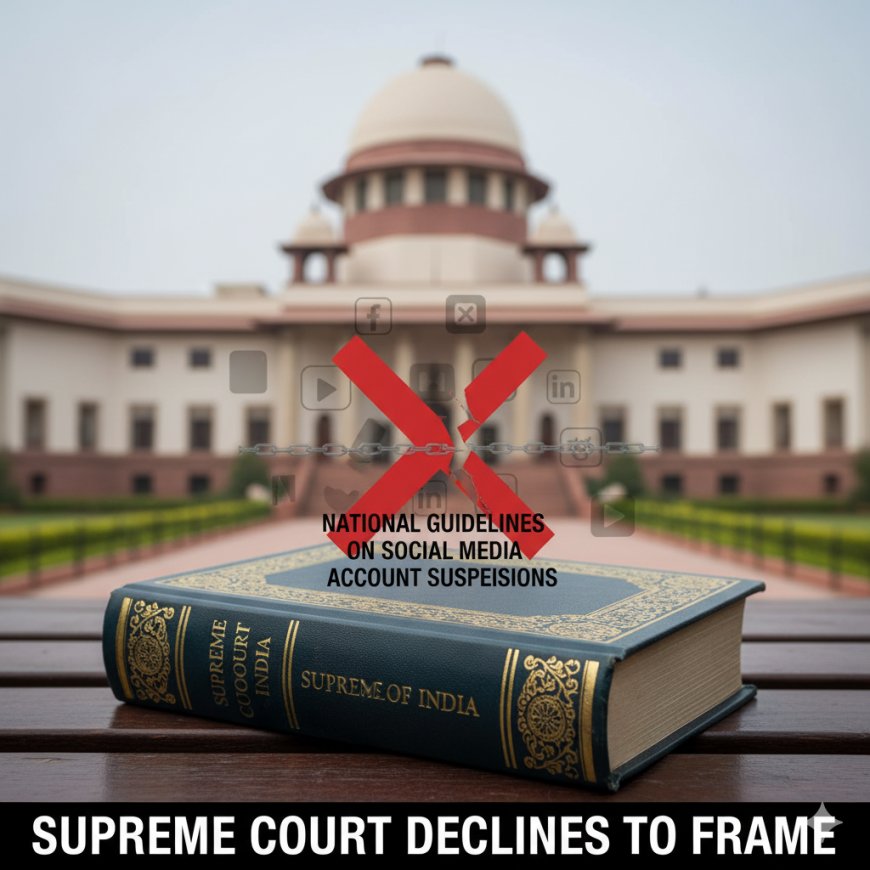
New Delhi, October 2025:
The Supreme Court of India has refused to entertain a petition seeking the formulation of uniform, pan-India guidelines for regulating the suspension or blocking of user accounts by major social media platforms such as X (formerly Twitter), Facebook, and Instagram.
The bench, led by Chief Justice D.Y. Chandrachud, observed that issues concerning the moderation of online content and account suspension policies fall under the domain of the executive and legislative branches, not the judiciary. The Court noted that social media platforms already function under the framework of the Information Technology (Intermediary Guidelines and Digital Media Ethics Code) Rules, 2021, which define the responsibilities of intermediaries in handling user-generated content.
???? Background of the Petition
The petitioner had requested the Supreme Court to direct the Centre to establish clear and transparent rules to prevent arbitrary suspension or blocking of user accounts, claiming such actions often infringe upon users’ rights to free speech and expression under Article 19(1)(a) of the Constitution.
However, the Court stated that any policy intervention must come from the Ministry of Electronics and Information Technology (MeitY), which regularly reviews and updates the IT Rules in response to evolving online behavior and content-moderation challenges.
???? Balancing Free Speech and Online Safety
During the hearing, the bench emphasized the importance of maintaining a delicate balance between individual freedom and digital accountability. It reiterated that while users have the right to express themselves freely, social media companies also have an obligation to prevent the spread of hate speech, misinformation, and harmful content.
Legal experts view the Court’s stand as a reinforcement of the principle of self-regulation among social media companies, combined with government oversight under the IT Act. The decision also signals that the judiciary expects the executive to take the lead in establishing more robust content moderation policies, especially in the age of AI-driven algorithms.
???? Public and Policy Reactions
The decision has sparked mixed reactions. Free-speech advocates argue that clearer rules are needed to curb arbitrary actions by digital platforms, while others welcome the move as a step toward ensuring flexibility in policy-making.
A senior official from MeitY stated that the government is already evaluating updates to the IT Rules to ensure fairness, transparency, and accountability in digital governance.
???? For more updates on governance, policy, and digital rights:
Visit ???? keymyhome.com — your trusted source for business and lifestyle news.
Plan your events and corporate gatherings with ???? weddsmart.com — India’s smart wedding and event planning platform